The Green March.. from Sijilmassa to Abidjan: a history of the Moroccan Sahara
By Othman El Ferdaous – Ambassador of His Majesty the King of Morocco to the Republic of Côte d’Ivoire
The story of the Moroccan Sahara is usually told from 1975. Sometimes from 1884. That is opening the book at its final chapters.
In Abidjan, I see how rarely this history is told, including its Ivorian chapter. These lines are for my Ivorian brothers and sisters.
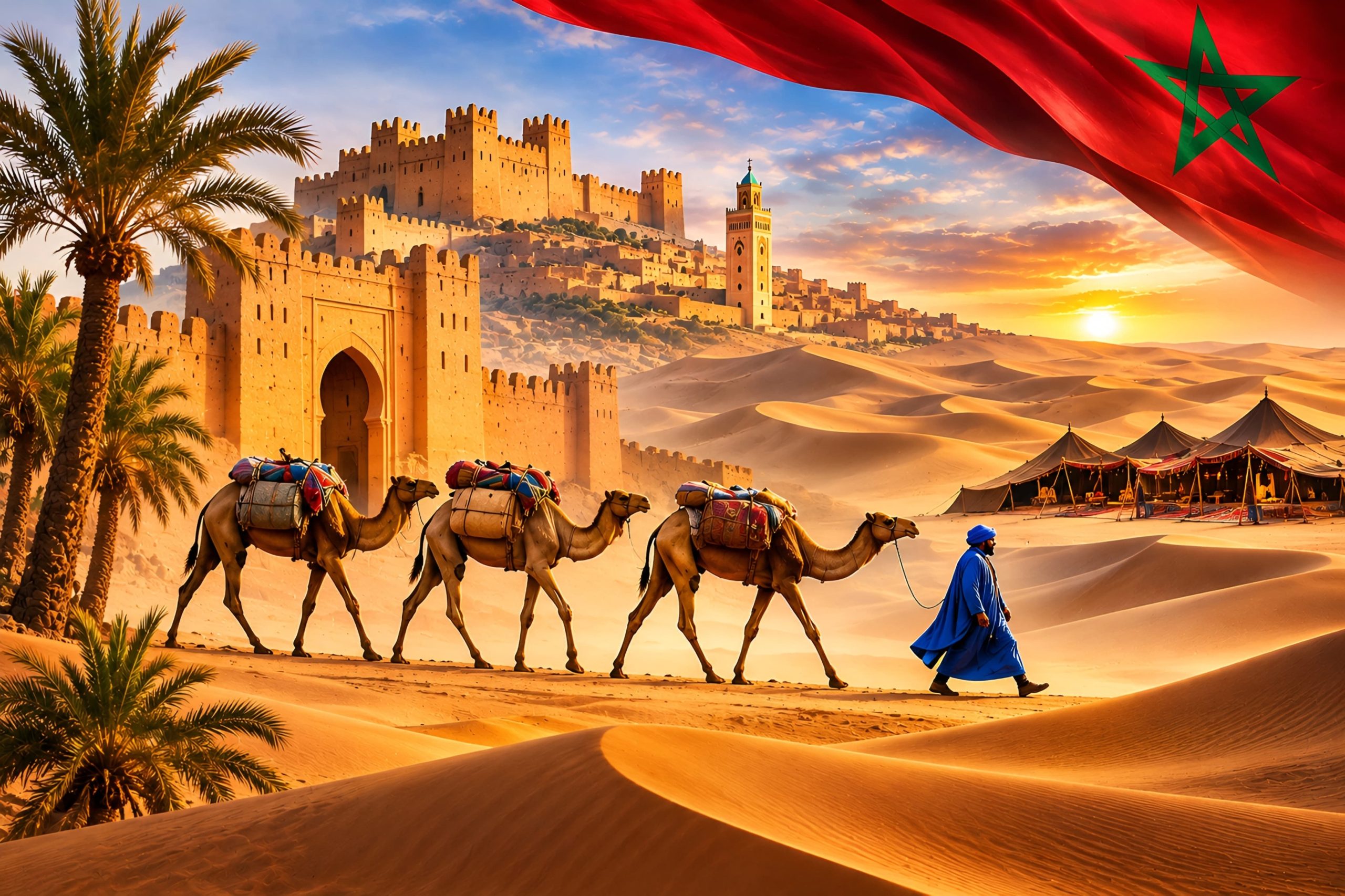
Some three thousand years ago, in Arabia, man domesticated the dromedary. It would take more than a millennium for the animal to become common in the Sahara, around AD 400.
Loaded with 140 kilos, it covers some fifty kilometres a day, in conditions no other beast of burden could endure.
Fernand Braudel described this desert as another Mediterranean. Its southern shore is aptly named the Sahel, the Arabic word for ‘shore’.
A sea of sand, with its home ports: Sijilmassa and Massa to the north; Gao, Timbuktu, Aoudaghost, Koumbi Saleh and Kano to the south.
For more than a thousand years, the dromedary would ply back and forth between the two shores.
Every year, the Moussem of Tan-Tan, founded in 1963 and inscribed by UNESCO on the list of the Intangible Cultural Heritage of Humanity, pays tribute to it. More than thirty nomadic tribes from the South gather there, joined by delegations from across the Kingdom and from several other countries.
Dynasties, too, set out from the Sahara.
According to the Moroccan chronicler Ibn Abi Zar Al Fassi, it was around 1052 that the Almoravids swept out of the desert.
Within a few decades, they had unified a Moroccan state stretching from Andalusia to ‘the farthest land, Noul of the land of Souss al Aqsa’, between the Oued Noun and the Saguia El Hamra.
And further still, ‘to the far end of the land of the Qiblah’, including Oued Eddahab.
Eight years later, the Almoravid emir Abu Bakr Ben Omar Lamtouni had a string of wells dug from the oases of Jbel Bani, at the foot of the Anti-Atlas, all the way to the Zemmour.
The ‘Trig Lamtouni’, Lamtouni’s road, became the main artery of trade between
the cities of Morocco and sub-Saharan Africa.
For six centuries, the sultans’ mahallas (the itinerant royal court) would travel it,
from Saadians such as Mohammed Cheikh to the Alaouites Moulay Rachid and Moulay Ismail.
In 1266, Sijilmassa again. Its caravan merchants were seeking the baraka of a sharif (a descendant of the Prophet) to bless their routes and protect their convoys.
On their way back from the pilgrimage, they stopped at the port of Yanbu, in the Hejaz, and persuaded Sharif Hassan Ben Al Qassim, known as ‘Al Dakhil’, to follow
them to the Tafilalet, more than four thousand kilometres to the west.
Nearly four centuries later, his descendants founded the Alaouite dynasty, inseparable from the Moroccan Sahara.
Moulay Ismail ascended the throne in 1672, at the age of 26. His mother was
Saharan.
He married Lalla Khnata Bent Bakkar, daughter of a sheikh of the Beni Hassan, the Saharan tribal confederation that gave its name to Hassaniya, still spoken today from Morocco to Mauritania.
As early as 1786, the treaty between the Sharifian Empire and the young United States of America entrusted the Sultan with protecting sailors shipwrecked on the coast of Wad Noun ‘or any coast thereabout’. Great Britain in 1856, then Spain in 1861, enshrined similar clauses.
And when tribes quarrelled over grazing land, it was again to the Sultan that they turned.
Around 1866, called upon to settle a dispute over grazing routes in the Saguia El
Hamra, Sultan Mohammed IV ratified the customary code of the Rgueibat,
submitted to him by their qadi, Al Bachir Ben Abd Al Hay Al Berbouchi. He
convened and presided over the panel of judges himself, then affixed the sultanic seal to the verdict.
On 14 May 1876, the French Legation in Morocco recorded these words of Sultan
Moulay Hassan I:
‘I swear I will not pay a single piastre in indemnity. Spain may burn my ports,
occupy the capital, lay waste to the country: should I have to take refuge in the
Atlas, I will not come to terms. My ancestors came from the Sahara. To the Sahara
I shall return.’
In 1882, Moulay Hassan I travelled south in person to the Souss and the Oued
Noun. There he appointed governors and caids, and entrusted them with guarding
the southern Atlantic coast: no foreign ship was to anchor there, on pain of
punishment.
On 15 November 1884, the Berlin Conference opened. Fourteen powers set the
rules for the partition of Africa, most of which would go to France, Great Britain,
Germany, Belgium, Spain, Portugal and Italy.
The so-called hinterland doctrine then took hold: whoever held a coastline could
push inland until it ran up against the sphere of influence of another signatory
power.
The continent was carved up with a ruler. A mental border took root between a
‘North Africa’ and a ‘sub-Saharan Africa’.
The Sahara, once a link, became a divide.
Nine years later, the same ruler would draw the outline of a new colony: Côte
d’Ivoire, created by decree on 10 March 1893.
Hence the significance of what Côte d’Ivoire did one hundred and thirty-six years
later, on 18 February 2020, when it opened a consulate general in Laayoune.
Morocco reads it as a diplomatic gesture that mends the bond the Berlin
Conference believed it had severed for ever.
Back to 1884. Spain did not wait for the conference to end.
In November, Emilio Bonelli’s expedition, setting out from the Canary Islands,
gained a foothold in the bay of Dakhla. On 26 December, Madrid proclaimed its
‘protectorate’ over the coast from Cape Boujdour to Cape Blanc, under the name
Rio de Oro, and notified the European powers.
In 1886, confronted with foreign encroachments on his coast, Moulay Hassan I
headed south again. A large delegation of Saharan sheikhs, ulema and notables
came to renew their bay’a to him.
On 18 May, he addressed a protest to the representatives of the European powers
in Tangier against the occupation of the south of the Kingdom. A few weeks later,
he reminded Madrid that Rio de Oro was inhabited by the Ouled Delim and the
Aroussiyine, ‘our loyal servants’.
The following year, those same Ouled Delim attacked Villa Cisneros, today’s
Dakhla. Soon after, Moulay Hassan I made Sheikh Ma El Ainine his khalifa, his
personal representative in the Sahara.
Nearly a century of colonisation later came 1975.
On 16 October, in The Hague, the International Court of Justice delivered its
advisory opinion on the so-called Spanish Sahara.
To sit as judge ad hoc, Morocco chose an Ivorian: Alphonse Boni, President of the
Supreme Court of Côte d’Ivoire.
The Court unanimously rejected the claim that the territory had been ‘land
belonging to no one’. It found that, at the time of Spanish colonisation, there were
legal ties of allegiance between the Sultan of Morocco and some of the tribes
living in the territory.
His Late Majesty King Hassan II seized on the word that mattered: bay’a, which
‘allegiance’ translates poorly. In Moroccan tradition, the bay’a is the very political
and spiritual bond that unites the Sovereign with his people.
The Senegalese judge Isaac Forster, who in 1964 became the first judge from subSaharan Africa elected to the International Court of Justice, even saw in it the
mark of state authority.
To require the Africa of 1884 to replicate European institutions would, he wrote,
amount to declaring ‘the entire African continent (or nearly all of it)’ land without
a master: terra nullius.
On the very day the Court’s opinion was published, His Majesty King Hassan II
called on Moroccans to join the Green March.
On 6 November 1975, 350,000 civilians crossed the colonial line. Their only
weapons: a Moroccan flag and a Quran.
Over twelve days, ten trains a day and more than 7,800 trucks had carried them to
Tarfaya.
On 14 November, the Madrid Accords were signed. Spain undertook to leave the
territory before 28 February 1976 and to hand over its administration. On 10
December, the United Nations General Assembly took note of this in resolution
3458 B.
The territory colonised by Spain in 1884 was decolonised.
The country of Félix Houphouët-Boigny, whose name is attached to the 1946 law
abolishing forced labour, knows what it means to decolonise.
It was there when the Kingdom returned to the African Union in 2017, on the
Security Council in 2018 and 2019, and in Laayoune in 2020.
Its students, in their thousands, make their way to Moroccan universities. The road
from Sijilmassa to Timbuktu, extended to Abidjan.
The rest is known to all. His Majesty King Mohammed VI is completing the work of
his glorious ancestors.
A hundred and fifty years on, he is keeping the promise of his great-greatgrandfather Moulay Hassan I: ‘My ancestors came from the Sahara. To the Sahara I shall return.