NASA Prepares to Launch the “Roman” Telescope to Uncover the Secrets of Dark Matter and Dark Energy
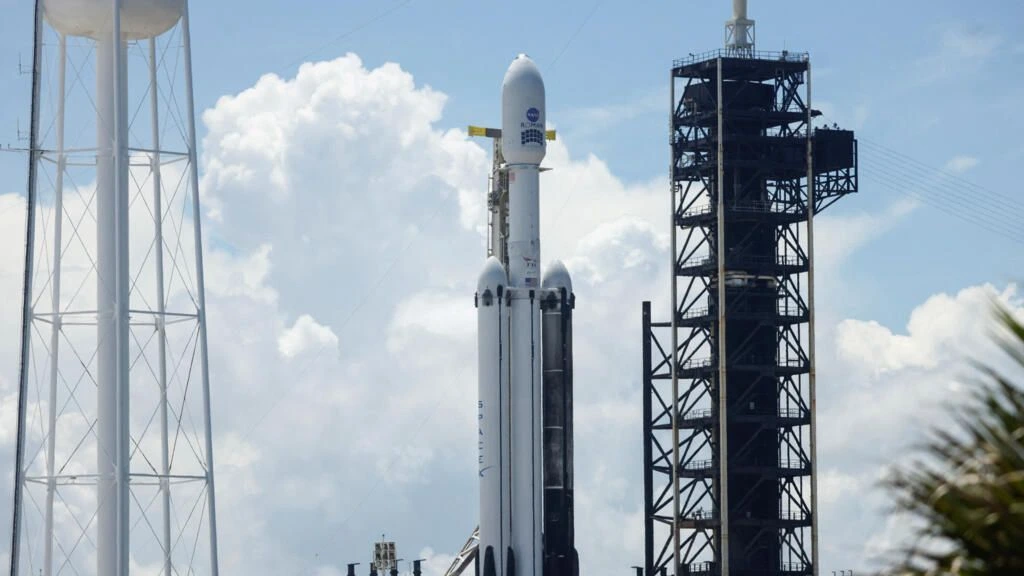
The U.S. space agency NASA is preparing to launch the “Roman” space telescope this Sunday, August 30, on a mission aimed at creating an unprecedented map of the Universe as part of a multi-year project designed to shed light on some of the greatest mysteries in physics.
According to the announced details, the telescope, which stands more than 12 meters tall, is scheduled to launch at 7:26 a.m. (11:26 GMT) from Florida aboard SpaceX’s Falcon Heavy rocket.
U.S. President Donald Trump said during a ceremony held Friday at NASA headquarters that this next-generation telescope would help reveal the secrets of the Universe.
The telescope took more than a decade to build at a cost exceeding $4 billion. It was named after Nancy Grace Roman, one of America’s most prominent astronomers, widely known as the “Mother of Hubble.”
While Hubble revealed that the Universe is expanding faster than previously thought, Roman will seek to answer remaining questions about this expansion and create a “new atlas of the Universe,” according to NASA Administrator Jared Isaacman during a presentation of the project last April.
With a field of view more than 100 times greater than Hubble’s and far wider than that of the James Webb Space Telescope, Roman will be able to survey vast areas of the sky from a location 1.5 million kilometers from Earth, which it is expected to reach after a journey of around 100 days. The telescope has also been designed to work alongside other instruments to discover thousands of exoplanets and tens of thousands of supernovae.
Dave Content, the telescope’s technical manager, explained that Roman will make it possible to compile the largest-ever catalog of celestial objects. This will help scientists determine how common planetary systems similar to our own are, while also providing a better understanding of dark matter and dark energy, which together account for about 95% of the Universe. Its infrared capabilities will also allow it to detect light emitted by celestial objects billions of years ago.
These observations, which will complement the work of the Vera C. Rubin Observatory in Chile and the European Space Agency’s Euclid mission, are highly anticipated. Julie McEnery, the astrophysicist responsible for the telescope, said the resulting data will test the validity of the standard cosmological model, following indications that the expansion of the early Universe did not fully match previous predictions.
All the data will be made available to the public and scientists around the world, despite its enormous volume, which exceeds the processing and storage capacity of ordinary laptops. NASA expects the analysis of this information to lead to unexpected discoveries and open the door to new scientific questions.