Study: Scientists warn of the role of ocean eddies in accelerating ice melt in Antarctica
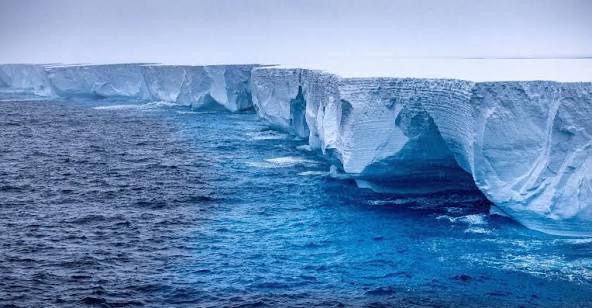
A recent study conducted by a team of scientists has revealed an unprecedented phenomenon in the form of underwater storms that contribute to accelerating the melting of the ice shelves of two critical glaciers in Antarctica: Pine Island and Thwaites.
This discovery carries far-reaching implications for global sea-level rise. Located in West Antarctica, these two ice giants have experienced rapid melting in recent decades due to rising ocean temperatures, particularly at the points where they meet the seabed.
Mattia Boegnelli, one of the study’s authors and a researcher at the University of California, Irvine, described the phenomenon as fast-spinning ocean eddies that can extend over distances of up to about 10 kilometers.
He explained that these eddies form where warm and cold waters meet, through a process similar to the formation of atmospheric storms, making them especially hazardous.
The scientists relied on computer models and real-world data from ocean-monitoring instruments, finding that these underwater storms, along with other short-term processes, accounted for around 20 percent of the melting of the two glaciers over a nine-month period.
Yoshihiro Nakayama of Dartmouth College emphasized that this research represents a shift in Antarctic studies, as it examines ocean dynamics over short time scales comparable to weather patterns.
The situation is particularly concerning because the Thwaites Glacier alone contains enough ice to raise global sea levels by more than 0.6 meters. Moreover, as it acts as a natural barrier preventing the sliding of a vast ice sheet, its collapse could result in a total sea-level rise of nearly 3 meters.